What I Had to Relearn as an Indie Developer
There is something deeply attractive about indie development.
There is something deeply attractive about indie development.
At least for me, the biggest advantage has always been freedom.
Freedom to choose your own ideas. Freedom to decide what to build. Freedom to explore weird concepts, test unusual directions, and spend time on products that may not make sense to anyone else at first. That kind of creative independence is rare, and it is one of the main reasons indie development feels so exciting.
But there is also a quiet trap hidden inside that freedom.
When you spend enough time building as an indie developer, it becomes very easy to stop seeing projects as projects and start seeing them only as business opportunities.
You begin to ask all the “right” questions.
- Will this make money?
- Is there a market for it?
- What is the monetization strategy?
- How hard will it be to acquire users?
- How do I position it?
- Can it grow?
- Can it become sustainable?
None of these are bad questions.
In fact, they are important questions. If you want to survive as an indie developer, you cannot ignore revenue forever. At some point, you do need to think about business, marketing, distribution, pricing, and sustainability. Otherwise, you risk building things that nobody uses and nobody supports.
So this is not an article against business thinking.
It is an article about what can happen when business thinking becomes the only filter through which you evaluate your ideas.
When every idea becomes a spreadsheet
I noticed this shift in myself gradually.
In the beginning, I built because I was curious. I built because something sounded fun. I built because I wanted to learn. There was joy in the process itself. Even when a project failed, it still felt valuable because I had explored something interesting and improved along the way.
Later, that changed.
Without really noticing it at first, I started evaluating every idea by its commercial potential. Even before the first prototype. Even before the first line of code.
An idea would appear, and almost immediately my mind would move to business mode.
- Is this monetizable?
- Does this solve a painful enough problem?
- Is the market too small?
- Is the niche too crowded?
- Would this be hard to market?
- Would I be wasting time compared to a more promising idea?
Again, these are reasonable questions. But when they arrive too early, they can kill something important.
They can kill energy. They can kill curiosity.
And sometimes, they can kill the exact project that would have made you excited to build again.
That was the point I reached.
I realized that I was no longer choosing projects only because I wanted to create them. I was choosing them because they looked more promising from a business perspective. On paper, that sounds smart. In reality, it made building feel heavier.
I had turned one of the most joyful parts of indie development into a constant exercise in evaluation.
The hidden cost of always optimizing
One of the most dangerous things about this mindset is that it does not look wrong from the outside.
You are being rational. Strategic. Focused. Disciplined.
And sometimes you really are making better decisions.But there is a cost.
When every project needs to justify itself financially before it even exists, you lose room for play. You lose room for experimentation. You lose room for passion-driven work the kind of work that may not look optimal at first, but often teaches you the most and keeps your creativity alive.
For indie developers, this matters more than it might in other paths.
Because when you work independently, your motivation is not just a nice extra. It is part of the engine. Curiosity matters. Excitement matters. Personal connection to the project matters.
If those things disappear, building starts to feel like obligation instead of expression.
And once that happens, even “good” opportunities can feel empty.
What I decided to change
At some point, I had to admit something to myself: My next project should not start from revenue potential.
Not because revenue is unimportant. Not because business does not matter. But because I needed to reconnect with the part of building that made me enjoy this path in the first place.
I wanted my next project to come from a different place.
I wanted to build something I had genuinely wanted to make for a long time.
Something fun. Something useful. Something that would let me learn.
Something I would still be happy to work on even if I knew from the beginning that it would not become a huge business.
That shift felt small in wording, but big in practice.
Instead of asking, “What project has the best business potential?” I started asking, “What project do I actually want to build?”
And that question led me to my current app.
Why I started building Push-Up Club
That is why I decided to build Push-Up Club.
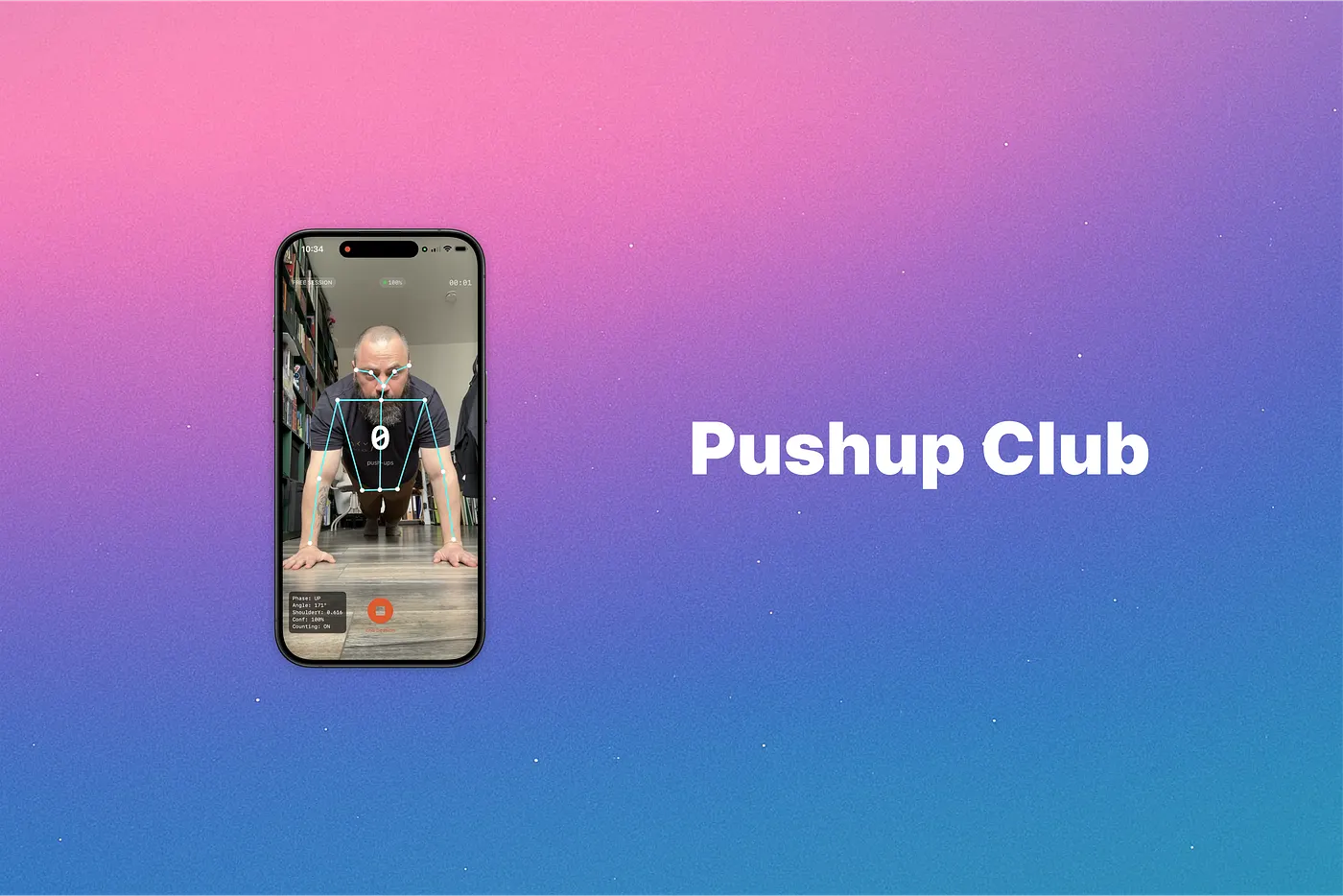
This project did not begin with a market spreadsheet or a monetization plan. It began with a simple feeling: I want to make this.
I had wanted to build something like this for a long time. It felt interesting. It felt challenging. It felt like the kind of product that would push me to learn new things and enjoy the process.
So I let that be enough.
And honestly, that decision changed the whole energy of the project.
Instead of measuring every step by commercial potential, I focused on making something I actually cared about. I focused on solving the technical challenges well. I focused on building a product that felt fun, useful, and satisfying.
One of the most important parts of the app is detection, and I spent a long time fine-tuning it. That process took patience, iteration, and a lot of adjustment, but it also reminded me why I enjoy building in the first place. There is something deeply rewarding about working on a problem until it finally starts behaving the way you imagined.
That feeling is difficult to quantify on a spreadsheet. But it matters.
The project gave me more than a product
What surprised me most is that once I stopped forcing myself to think like a business analyst first, I started enjoying the work more and in some ways, doing better work because of it.
I felt more patient. More engaged. More willing to improve details. More willing to learn.
When you care about the thing itself, not just the outcome, your relationship with the work changes. You are not only trying to extract value from the project. You are trying to create value through it, for yourself, for users, and for the experience of building.
And maybe that is the balance I had been missing.
Business thinking is valuable. But it should support creativity, not replace it.
Indie development should have room for both
I do not believe indie developers should ignore money. That would be unrealistic.
If you want to keep building long term, sustainability matters. Revenue matters. Learning how to market your work matters. Taking your projects seriously matters.
But I also do not think every project must begin as a calculated business move.
Some projects should begin with curiosity or with joy. Some should begin with, “I’ve wanted to build this for a long time.”
And sometimes, those projects end up being the most meaningful ones anyway.
Not everything valuable can be measured in immediate revenue. A project can be worth building because it teaches you something.
- Because it re-energizes you.
- Because it helps people.
- Because it improves your skills.
- Because it reconnects you to your craft.
- Because it is simply fun.
That last reason is more important than many of us allow ourselves to admit.
A reminder I needed
If there is one thing I have had to relearn, it is this:
- Building something for fun is not a waste of time.
- Building something because you genuinely care about it is not naive.
- Building without optimizing every decision for monetization is not irresponsible.
Sometimes it is exactly what you need.
Sometimes the most productive thing you can do as an indie developer is protect your excitement.
Because once excitement disappears, everything becomes harder: the coding, the iteration, the problem-solving, the patience, the consistency.
And once excitement returns, even difficult work feels meaningful again.
What comes next
Pushup Club is still on its way, but I am happy with how it is progressing.
The app is already working well, especially the detection, which I have been refining for quite a long time. And maybe even more importantly, this project reminded me what I want my work to feel like.
Not only strategic.
Not only optimized.
Not only monetizable.
But also playful, interesting, useful, and alive.
The app will be available soon, and it will be completely free.
Because this time, I did not start with the question, “How do I make the most money from this?”
I started with a better question:
“What do I actually want to build?”
And for me, that made all the difference.