How to Know If Your Mobile App Idea Is Worth Building (5 Simple Steps)
Most mobile apps don't fail because of bad code. They fail because nobody needed them.
Most mobile apps don’t fail because of bad code.
They fail because nobody needed them.
Before you spend months building, designing, and polishing an app, you should answer one simple question:
Do people actually want this?
Over time, I’ve built a 5-step validation process that helps me decide whether an app idea is worth building — before writing a single line of code.
Let’s go step by step.
1. ASO Keywords: Do People Actually Search for This?
The first thing I always check is ASO keywords.
Before thinking about features or design, I want to know one thing: are people even searching for an app like this?
ASO tools help answer that very quickly. They show how often users search for a keyword and how difficult it is to rank for it.
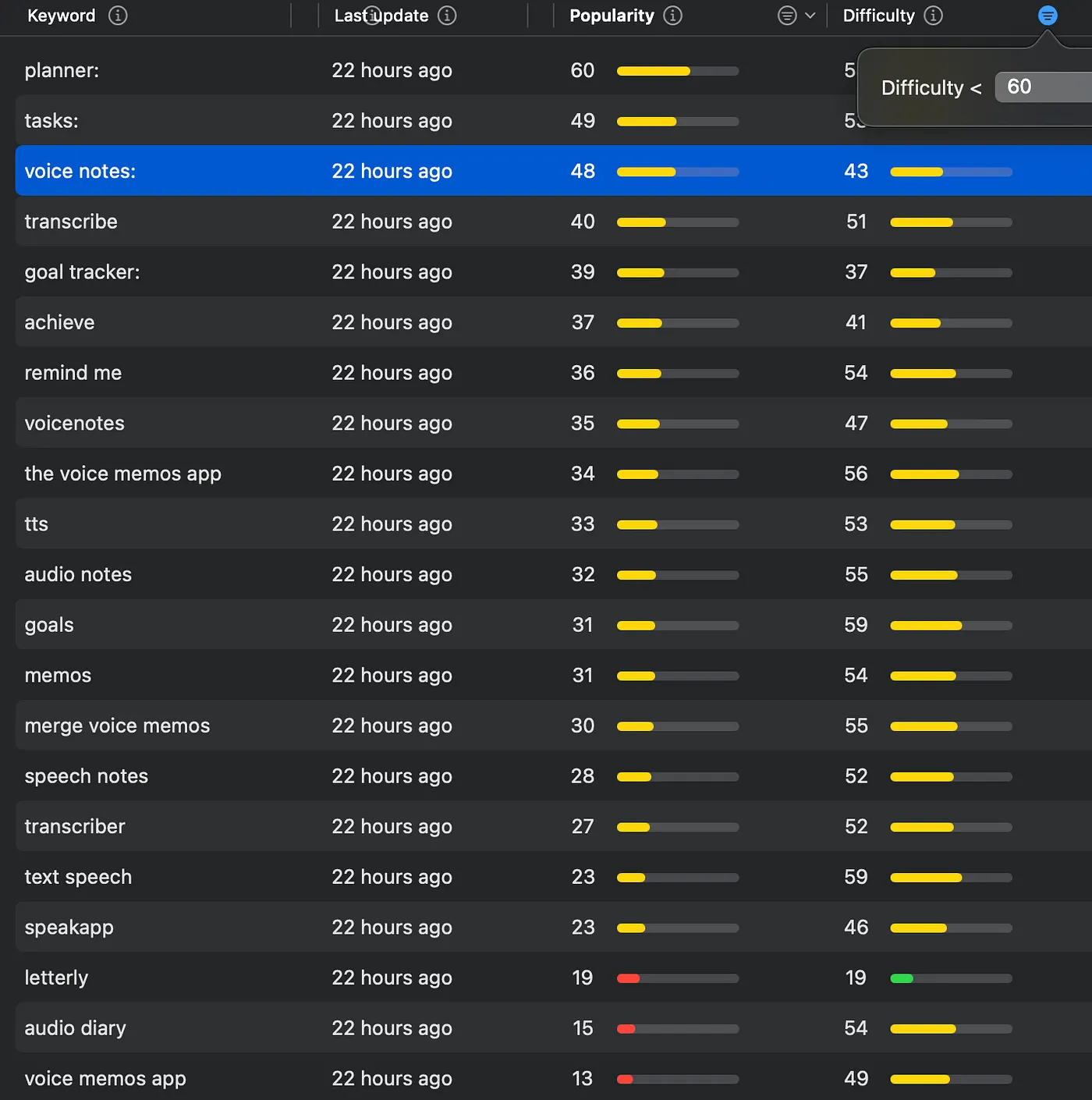
When I analyze keywords, I focus on two numbers:
- Popularity: higher than 20
- Difficulty: lower than 70
This range is not easy to find, but when it exists, it’s a very strong signal.
High popularity tells me that real users are actively searching for this type of app. Lower difficulty means that the market is not completely dominated by big players, so a new app still has a chance to be discovered.
If I find several keywords in this range, it usually means two things. First, the problem is real. Second, there is still room for a new solution. At this point, the idea already feels much safer than something nobody is searching for.
This is usually my first green light.
2. Competitors & Reviews: Proof That Users Exist
After checking keywords, the next thing I look for is competitors.
Many people think that having no competitors is a good sign. In reality, it’s often the opposite. If nobody has built something similar, it usually means one of two things: either there is no real market, or the problem is not painful enough.
Seeing competitors is actually helpful. It tells me that people are already using apps in this space and that the problem is real.
At this stage, I don’t just look at the app names. I download the apps one by one and go through them carefully. I check their features, their onboarding, and how smooth the experience feels. While doing this, I try to spot weak points places where the app feels confusing, incomplete, or outdated.
Then I move to the App Store reviews. This is one of the most valuable parts of the process.
Users often explain very clearly:
- what doesn’t work,
- what is missing,
- and what frustrates them the most.
These reviews give me ideas for improvement. Sometimes the opportunity is not to build something completely new, but to build a simpler, clearer, or more focused version of what already exists.
If apps have many reviews, it means real users care. And if users complain, it means there is space to do better.
3. Revenue Signals: Is the Market Willing to Pay?
Once I know that users exist, the next question is simple: are they paying?
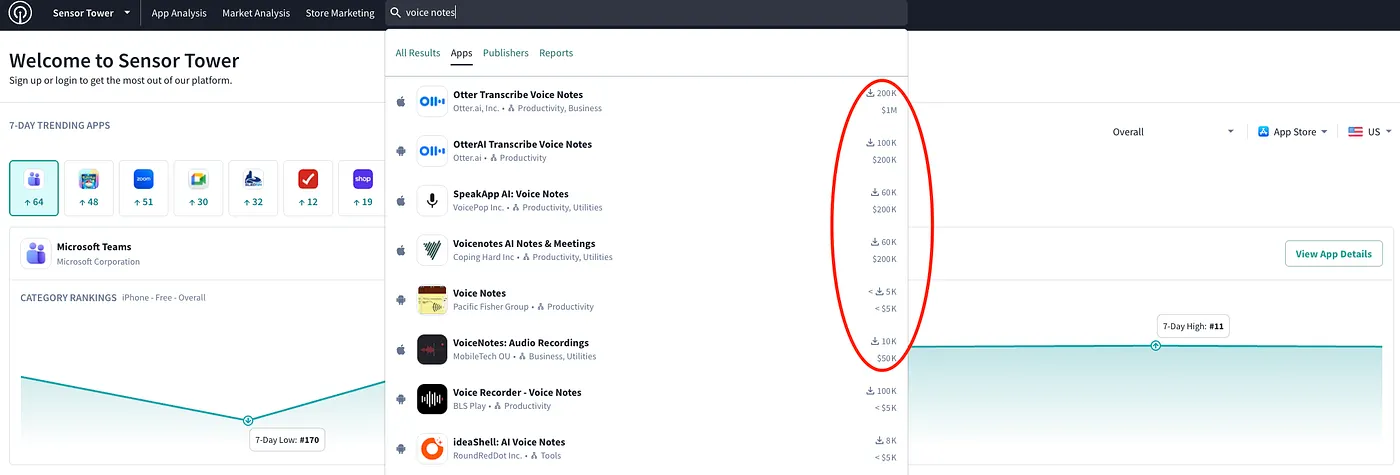
To answer this, I check revenue estimates using external tools such as Sensor Tower. These numbers are not perfect, but they are good enough to understand the size of the opportunity.
When I look at revenue, I focus on two levels:
- More than $20,000 per month → strong signal
- Less than $5,000 per month → usually too risky
Higher revenue shows that users are willing to spend money to solve this problem. It also means that the market is large enough to support more than one app.
I usually avoid ideas where competitors make less than $5,000 per month. The reason is simple: small numbers come with bigger estimation errors. Real revenue might be even lower, and that increases the risk a lot.
If there is no money in the market, it doesn’t matter how good the idea sounds. Building an app takes time and energy, and this step helps me avoid investing both in the wrong place.
4. Google Trends: Is Interest Growing or Fading?
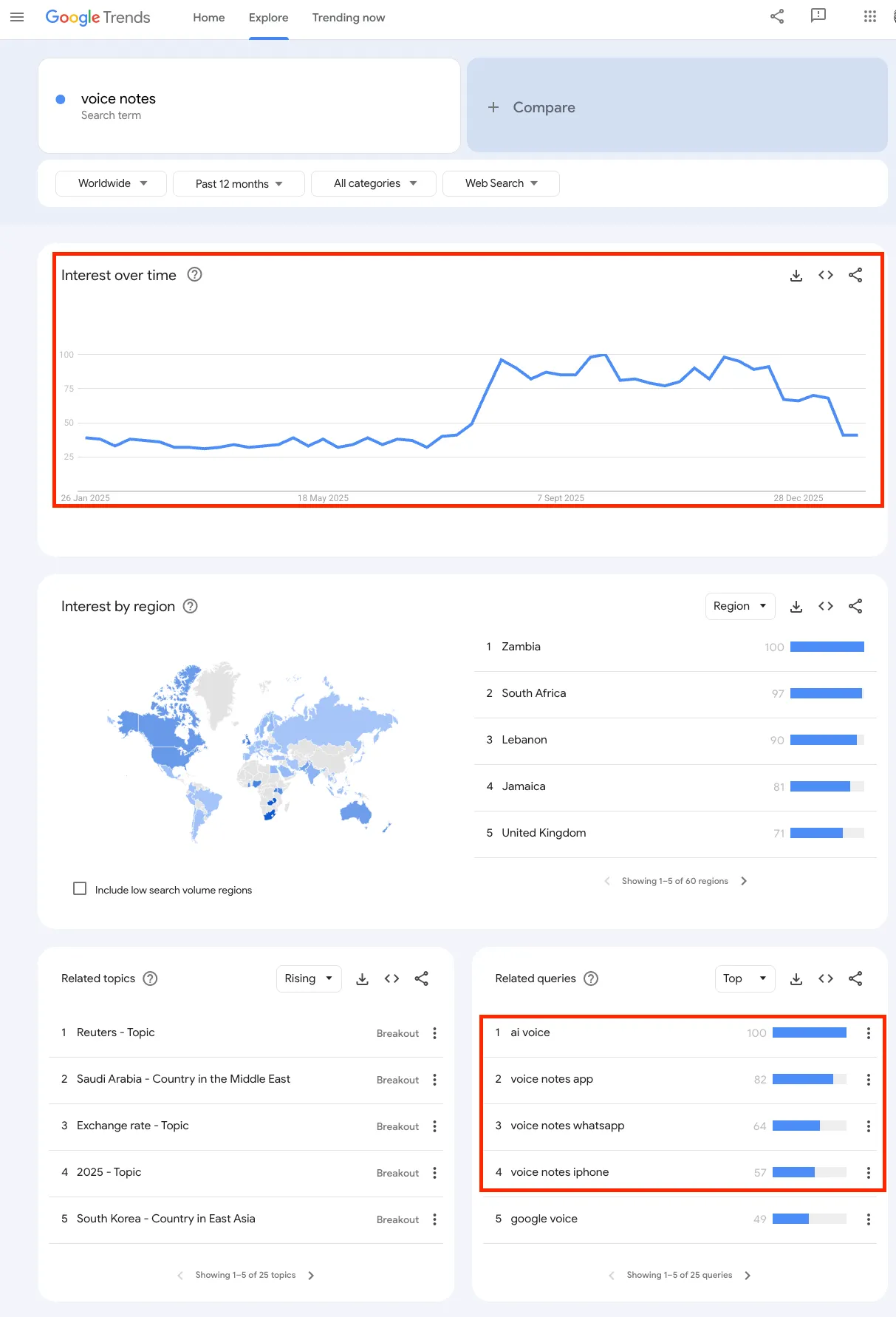
After checking money, I want to understand timing. This is where Google Trends helps.
Google Trends shows how often people search for a keyword over time. It helps me see if interest in a problem is growing, stable, or slowly disappearing.
What I like to see most is a growing trend. That usually means more people are starting to care about the problem, which makes it a good moment to enter the market.
Stable trends can also work well, especially if the problem has existed for years. Falling trends, however, are a warning sign. They often mean that people are moving on to other solutions or that the problem is becoming less relevant.
This step is also useful for marketing. Keywords from Google Trends can be used later for landing pages, blog posts, or even LinkedIn content. That way, the app doesn’t depend only on App Store search, but can get users from outside as well.
5. Reddit: Where Real Problems Are Spoken Out Loud
Reddit is one of the most honest places on the internet, and that’s why I use it for validation.
People on Reddit don’t try to sound professional. They describe real problems, real frustrations, and real experiences. Often, they explain things in a way you would never see in surveys or polished interviews.
When I search Reddit, I look for:
- repeated questions,
- long discussions,
- emotional posts,
- and clear pain points.
This helps me understand not just that a problem exists, but how people feel about it. It also shows what users have already tried and what solutions failed for them.
Reddit often answers a very important question: what exactly should this app solve?
Not in theory, but in real life.
Why I Stopped Using Networking Events for Validation
In the past, I tried validating ideas through networking events. Today, I don’t do that anymore.
The main reason is simple: the signal is very weak.
At most business networking events, people are there to pitch their own products. They want to sell. Real problems rarely come up, and honest feedback is hard to get.
Compared to online data keywords, reviews, revenue, trends, and Reddit networking events require much more effort and usually give much less value.
That’s why I prefer data over small talk.
Final Thoughts
This process doesn’t guarantee success.
But it helps avoid bad ideas.
Validating an app idea before building it saves time, money, and motivation. It turns guessing into informed decisions.
Before you build, validate first.